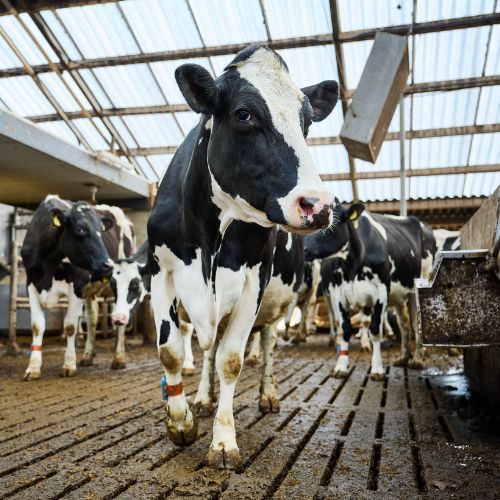
15 November 2023 Robotic milking: how to optimise cow traffic
An efficient barn where everything runs like clockwork. This is what many dairy farmers wish for. Are you working with a milking robot or planning to get one? If so, you’ve already made a big step in reducing your workload. But where in the barn is the best place to put that robot? How do you optimally organise cow traffic in your barn? Unfortunately, no ready-made plan is available. After all, every barn is different. Fortunately, Fullwood dealers Willem van der Weerd (R. van der Weerd Melkmachines BV) and Doede Hofman (Bosch HIT BV) are here to advise you from the Netherlands.
Determining the best spot and lay-out
Are you planning to use milking robots in your newly built or existing barn? If so, it is wise to think carefully about the lay-out. ‘It’s very important to take cow traffic into account,’ says Doede. ‘What is a logical route for your animals to take? What are possible intersections or places where congestion could occur? By taking these kinds of variables into account, we can determine the best place for your robots and the best type of lay-out to use.’
‘The choice you ultimately make must be well founded,’ Willem adds. ‘We often work out several variations of lay-out that could work for a particular barn. We discuss the advantages and disadvantages and always view barn situations live, so that as a farmer you get a good idea of the possibilities.’
Lay-out and access options
There are numerous lay-out from which to choose. For example, you have a continuous lay-out, tandem lay-out and head-to-head lay-out. There are also different access options for the milking robot.
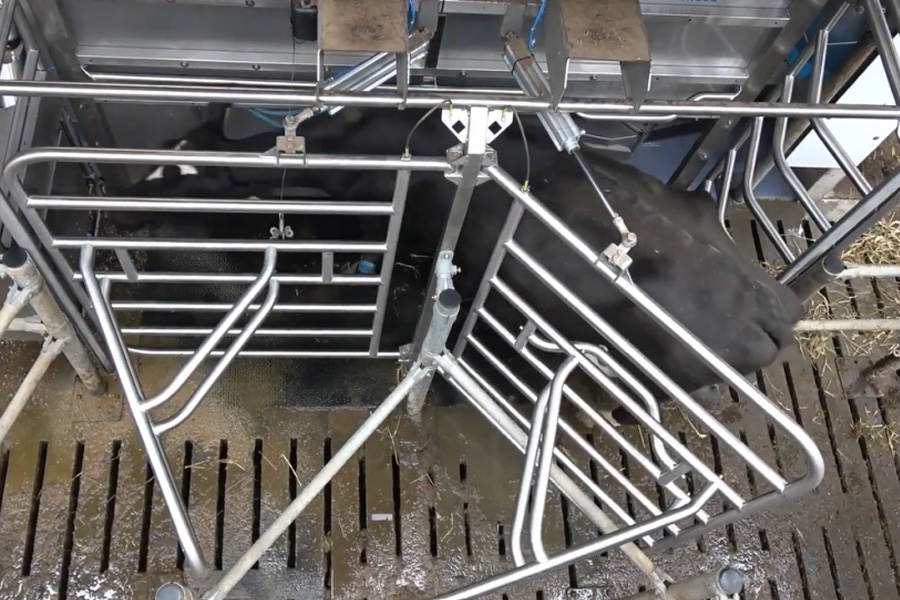
If you choose the Merlin 2+ milking robot from Fullwood, you can use both a straight entry and exit or an entry and exit from the side, and possibly even a combination. ‘That’s a big advantage,’ says Doede. ‘This actually gives us more tools to fit the robots properly into existing barns. Willem: ‘The advantage is that this way we can always achieve ample access. This is because it is important that cows have enough freedom of movement to enter the robot. With other brands, you either have straight access only or from the side only.’

Checkout lay-out: the benefits
There is no single, correct barn lay-out, in fact, there is something to be said for every lay-out. For his customers, Doede definitely sees the benefits of the checkout lay-out. ‘Imagine a cash register at the local supermarket,’ he explains. ‘There are several robots next to each other where the cows can walk straight in and out. The advantage? You have very little congestion.’
‘That congestion in cow traffic is something you want to avoid as a livestock farmer,’ Doede continues. ‘There are always a few bosses among them, high up in the hierarchy, who call the shots. If they occupy a prominent place in the waiting area, lower-ranking cows are less likely to stand there as well. You then get a kind of schoolyard situation.’
‘There is a chance that these cows will not be milked or will be milked too late when they need to be milked at that time. We have found that this type of congestion is more likely to occur with other lay-out types.


Tandem lay-out
Willem uses the checkout lay-out less for his customers, but so far has had few problems with hierarchical behaviour. As far as he is concerned, the tandem lay-out works like a charm. ‘This lay-out suits many barns well because you have more space and freedom of movement in lots of places,’ he says. ‘When entering and exiting the robot, for example. The cows follow a fairly natural walking route with no tight turns. Plus, you can work with multiple waiting areas and the cows can see the herd from the robot.’
‘We often choose a tandem lay-out in a head-to-head version,’ Willem continues. ‘This involves milking the cows while they are facing each other. The advantage is that you have both a left and a right robot at your disposal. That is, the cow is milked from the left side at one robot and from the right side at the other robot. Cows often prefer one side to the other. The great thing is that they can choose in this lay-out.’

The Merlin 2+ as a segregation gate
The Merlin 2+ milking robot can separate cows for you after milking. For example, towards the pasture, immediately acting as a grazing gate. ‘If you graze your cows, you have to deal with a lot of variables,’ Doede explains. ‘It’s mainly a matter of keeping the cows motivated. It’s finding a balance in using different plots to keep the cows happy and the grass good.’
The Merlin 2+ can also separate towards a straw bedded pen for sick cows or cows in heat, or towards a hoof trimming box, for example. Willem: ‘If you place such a separation area behind the robot, the advantage is that you can keep the cows in the right area. This allows them to get to the robot and back to the separation space. When they are ready, they can rejoin the herd.’
Milking is emotion
Is there only one correct robot lay-out? The answer is no. There are several possible starting points and variations, and it is especially important that they suit what you as a dairy farmer consider important.
What space does your barn offer, how does cow traffic flow and what lay-out best suits this? And what do you consider most important? For example, do you want your cows to avoid unnecessarily long walks or tight turns that may cause physical problems? Or do you want your cows to be able to walk freely everywhere without stress building up? Or do you mainly go for the spatial aspect (spacious corridors and walkways)?
Your Fullwood dealer has the right knowledge to advise you on the options and solutions that best suit your needs. Each of our dealers has accumulated a wealth of experience. ‘Milking is emotion,’ Willem concludes. ‘Your cows determine your worth as a livestock farmer. Their constitution, health, milking capacity and quality determine your income. If there’s a kink, it can have huge consequences. We help you make the best choices for your situation.’
Want to know more?
Want to learn more about cow traffic, the different robot lay-out and the possibilities for your barn? Contact your local dealer.