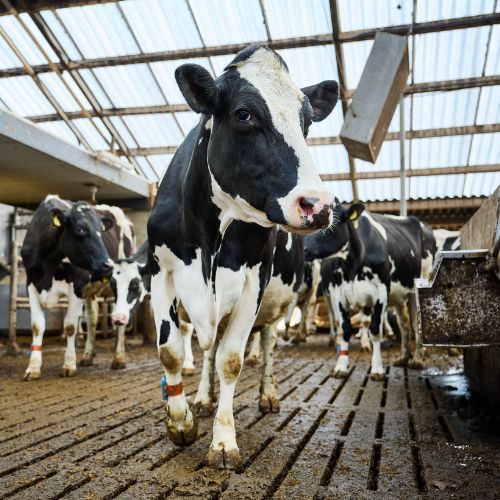
Transitioning your cows smoothly to Daylight Saving Time
Summer time officially begins when the clocks are moved forward by one hour during the night of Saturday, March 30, to Sunday, March 31. This change affects humans, but it also affects animals, especially cows. Their lives have a specific rhythm of set routines, so how can you best prepare your cows to transition to Daylight Saving Time? And will the change affect your farm differently depending on whether you use a traditional milking parlour or a milking robot? Find out in this article.
Summer time: a human invention
Winter time is actually our standard time. Daylight Saving Time was introduced in the Netherlands in 1916 and has been in use in many countries since the early 1900s. It was devised to extend evening daylight so that people could use less gas and oil. It’s a good idea, but it’s an artificial device, and not everyone thinks it’s useful. The time shift can affect humans in a similar way to jetlag, but it also disrupts animals’ biorhythms.
The impact on cows
The transition to winter time and summer time has a significant impact on cows. That’s because cows are creatures of habit; they know precisely when they will be milked and fed and when it’s time to sleep. Without human intervention, the transition to Daylight Saving Time – and winter time – can leave cows confused. This is especially true in the first week, when cows might be disoriented by the change to their milking schedule.
Adjusting the milking parlour schedule
‘If you have a traditional milking parlour, it’s a good idea to move the milking schedule forward gradually,’ suggests Tinus de Jong, a dealer for Fullwood. He has found that cows’ rhythms change with the transition to winter and summer time. This can affect several things, including milk yields.
‘If you move the cows’ clock forward gradually, for example, in 15-minute increments over the course of a whole week, you can allow the cows to slowly get used to the change to their schedule,’ he explains. ‘Choosing not to do that and instead moving their clock forward by the whole hour all at once could cause the cows to let their milk down, which will reduce yields. By introducing summer time gradually, you can minimise this milk loss.’


How does it affect farms with milking robots?
Farmers who use milking robots have an advantage, in Tinus’ opinion. ‘If your cows are milked by a robot, they can decide for themselves when to go to the parlour,’ Tinus explains. ‘That doesn’t change when the clocks go forward, so if you use a robot, you won’t need to adjust milking times.’
‘The one thing you do have to consider is that the robot may report a lower yield,’ Tinus continues. ‘Because the clock moves forward, you effectively lose an hour on the first day of Daylight Saving Time. That could cause the robot’s data on the distribution of milkings to look slightly different because the robot “thinks” the cow took an hour longer to come to be milked. The cows don’t notice much difference, but it’s useful for dairy farmers to know.
Adjusting feeding
Does this mean that robotic farms don’t need to make any adjustments at all? ‘Not necessarily,’ says Tinus. ‘In fact, the clocks going forward can influence more than just milking. The change especially affects feeding times, particularly if you work with set feeding times.’
‘If you feed your cows once or twice a day, I recommend gradually moving those times forward as well,’ says Tinus. ‘As with milking times in the parlour, this allows the cows to slowly get used to their new feeding schedule.’
However, if you have a feed pusher robot, then just as with robotic milking, the change will have little impact, according to Tinus. ‘The cows always have feed available at the fence. You could slightly adjust the timing of fresh feed, but what’s important is making sure cows don’t have to wait too long compared to their original feeding time.’
Switching to a standard time?
Would it help to return to using one standard time and settle on using either winter or summer time? ‘That would at least mean not having to deal with these transitions,’ Tinus tells us. ‘But in either case, you would find that you don’t always have enough light when you need it. In winter it’s dark until very late in the morning; in summer, it gets light much too early. There are times when you can’t do anything much with the available light. So there’s no real solution. Until there is one, we can at least help the cows by slowly getting them used to the new time.’
Want to know more?
Want to learn more about how to prepare your cows for the start of Daylight Saving Time at the end of March?