Bart Spronk 'It doesn't have to be bigger, but as efficient as possible'
Bart Spronk runs dairy farm ‘t Wissel in Noordeinde, Gelderland, together with his wife Janneke and their four daughters. They keep 130 dairy and calving cows and 80 head of young livestock on their 85-hectare farm. Spronk actively engages in nature and meadow bird management and grows his own roughage. Besides cows, Bart has 60 breeding sheep (Texelaars) and four KWPN-mares with which he breeds.
Family business
Dairy farm ‘t Wissel is a real family business. Bart took it over from his father, who ended up on this site due to land consolidation 40 years ago. In recent years, Bart has focused mainly on optimizing the business: ‘It doesn’t need to be any bigger, but I would like the way of working to be as efficient and convenient as possible.’
From herringbone to Merlin 2+s
One of the main optimisations was the replacement of the milking parlour. Bart milked for years in a 2×6 herringbone parlour. ‘I was milking for 2.5 to 3 hours every time,’ says Bart, who also chose milking robots because of his health. ‘I suffer from arthritis in my joints.’ In 2020, the cubicle barn built in 1983 was thoroughly renovated. The roof was replaced, a new feed fence was installed and the old milking parlour made way for two Merlin 2+ milking robots from Fullwood.
Happy with the choice
Bart is happy with his choice of the Merlin 2+s from Fullwood. ‘The cows can go wherever they want. And I have more time for the cows that really need it. Plus, I am no longer tied down to fixed milking times. That’s a big benefit with a busy family life.’
He appreciates the Merlin 2+s’ milking technique. Thanks to Streampulse milking technology, the cows are milked well. ‘Connecting with the electric arm goes very well. You can hardly hear the robots and the cows feel comfortable. The herd stays very calm,’ says Bart. The Merlin 2+ milking robots also provide important information. Every morning, Bart opens the Robot Dairy Herd Management programme on his computer. ‘I check to see if all the cows have been milked on time. If that is not the case, there is usually something wrong.’


Increased annual production
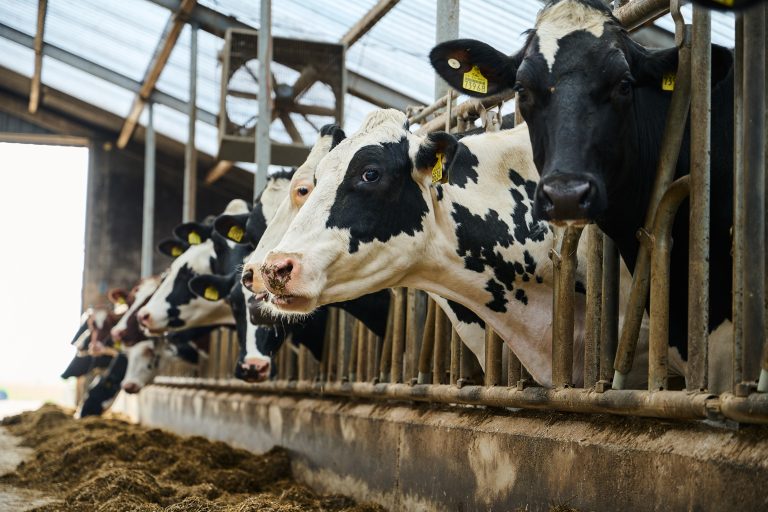
The cows can move freely in the barn. The dairy cows can approach both robots and Bart sees that his cows know how to find the Merlin 2+s. The average number of milkings fluctuates between 3.5 and 3.7 per cow per day in winter. In spring, production is around 41.3 litres per cow per day. ‘That’s unprecedented,’ says Spronk. ‘In the previous situation, annual production was tight at 9,000 litres per cow. The rolling annual average has now risen to 11,000 litres.’
The farm has already produced several 100,000-litre cows. Spronk is most proud of the cow that is now on the 140,000-litre mark and still in full production. ‘She was already at 100,000 litres before the arrival of the milking robots. It would be great if she could break our farm record of 142,000 litres,’ says the proud dairy farmer.
Healthy and fertile cows
Bart is happy that his animals are doing well: ‘I like walking among the cows. They look well. ‘Not only is milk production higher, but the condition and fertility of the animals have also clearly improved,’ says Bart, who inseminates his animals himself. ‘I am at 1.6 inseminations per gestation. With the pinks, it’s 1.4.’
Job satisfaction
In the coming years, the dairy farmer intends to further optimise his farm. ‘But nothing too drastic, because most of the business is now the way I want it. I still want to tackle the yard, work on the feed storage and possibly build another shed. Overall, I’m very satisfied here. Things are in good shape and I enjoy my work. That’s important to me; job satisfaction is something I need.’
Want to know more?
Would you also like to optimise your business with Fullwood’s help?
