Freerk Oudman 'The milking robots give me clear data about how effective my actions are'
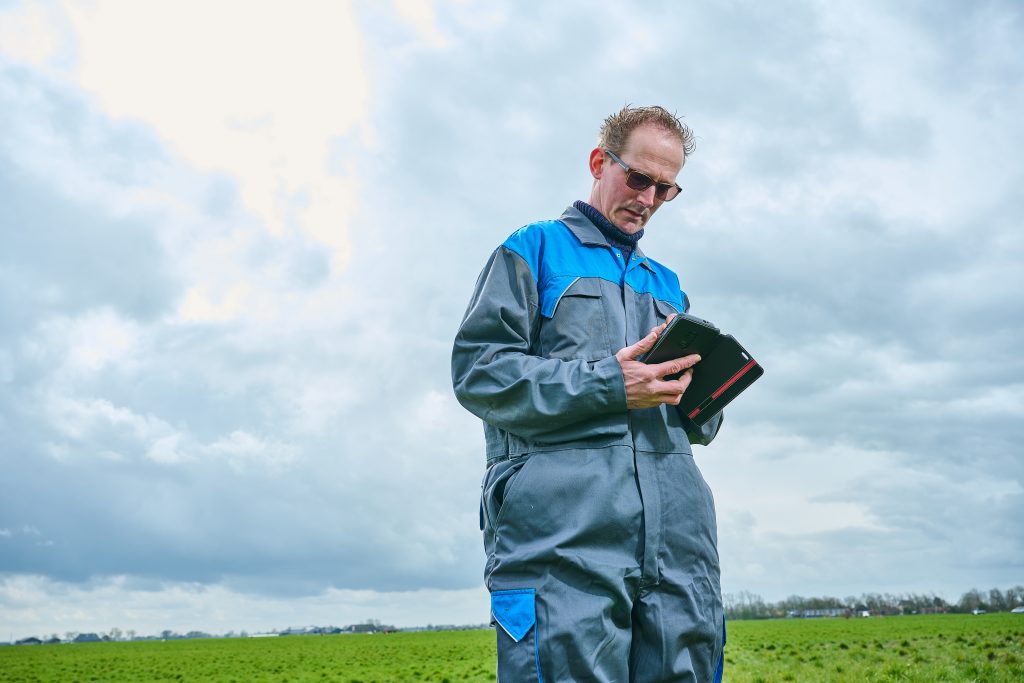
The Oudman dairy farm in Rottum switched to robotic milking in February 2020. After deliberate and careful consideration, they were confident in their decision to purchase two Merlin 2+s from Fullwood. Freerk Oudman and his father Henk have 120 dairy and calving cows and 45 head of young stock on 67 hectares of land. Freerk tells us about their experiences.
Turning data into decisions
The Oudman family has been farming in Rottum since 1987. Freerk was involved in his parents’ business from an early age. After working elsewhere for a while, he eventually decided to return to his childhood home. Since then, Freerk tells us, farming has changed completely. ‘When my father was still milking in the parlour, he had to rely on his own judgement in the pit. This was a key moment of contact with the cows and everything was entirely visual.’
‘Nowadays, as a farmer, you’re much more concerned with data, especially if you milk with robots. You can analyse the content levels in the milk, measure conductivity, use sensors to monitor the milk’s colour and you can even track activity. This gives you all kinds of information before you even walk into the barn to observe the cows. It allows you to respond much faster.’
Testing for optimal results
Dairy farmers now have access to a wealth of useful information. ‘Data on milk contents and production levels mean you can test what works well and what doesn’t,’ says Freerk. ‘For example, you can try out different feeds so you can optimise rations. We want to make the cows’ lives as comfortable as possible because the happier they are, the more milk they produce.’
Freerk has made tweaking feed composition something of a hobby. ‘Is the fat content too low? Then it’s likely that some of your cows have rumen acidosis, and you need to address that,’ he explains. ‘A high fat content, on the other hand, could indicate bovine ketosis. If lactose levels drop and urea levels rise in autumn, the cows need more energy. If you correct that properly, you’ll see a decrease in urea levels and an increase in protein and lactose levels.’
‘The beauty of the Merlin 2+ milking robots is that I can really test if my actions are having an impact. The data gives me clear information about how effective they are. By constantly making adjustments, you can achieve great results. It’s an ongoing puzzle.’
Grazing combined with robotic milking
The same goes when combining robotic milking with grazing. The Oudmans have a strong focus on grazing. From April to September, roughly 80% of the forage ration comes from pasture grass. However, this is not something you can simply switch to overnight. To make sure the process goes smoothly, you need to adapt your barn to deal with it. Freerk: ‘Grazing in combination with robotic milking is a puzzle and can be quite challenging. We gave a lot of consideration to it when we installed the robots.’
Grazing was a priority in the planning phase. ‘The dealer drafted designs that really took our grazing needs into account,’ says Freerk. ‘That was very helpful. The animals use different paths to go in and out, so they avoid crossing each other. That makes a huge difference.’
An efficient set-up for separation
The farm’s two Fullwood Merlin 2+s are positioned at right angles to the old feed alley. The cows are milked facing each other. ‘We didn’t go for what looked like the easiest solution,’ says Freerk. ‘We thought carefully about the layout and what would be best for grazing. For example, we use a three-way separation gate and two separate exits to move the cows in the right direction. That allows us to get the maximum benefit.’


Robot-assisted grazing management
Grazing selection is managed via the robots. The first cows are separated from the others and let out to graze at 4.00 am. At 8.00 am, Freerk retrieves the last of the cows from the field and by 10.00 am, the barn is empty. Cows that return from grazing are kept in the barn until 3.00 pm so they can be fed some corn or beet pulp, and then they are automatically given access to a second grazing area.
At night, the cows go back and forth between this area and the barn. Freerk: ‘This way, we can capitalise on the cows’ tendency to eat faster early in the morning and in the evening, taking larger bites so that they consume more grass.’
‘This set-up allows us to easily achieve an average of 2.7 milkings a day,’ Freerk points out. ‘It is very important to keep the cows motivated, though. You can try to control everything, chasing the cows down and forcing them to do what you want, or you can entice them to do certain things at set times. The latter works much better and it’s a lot more pleasant for us too.’
A considered choice
Freerk and Henk took time to make their decision to buy Merlin 2+s. They visited nearly 20 dairy farms and had multiple quotes drawn up. The dairy farmers became convinced of the benefits of Fullwood’s milking technology. Freerk: ‘We were won over by the quiet milking technology with the electric attachment arm. The cows are milked quickly and effectively, and the robots suit our farm well.’
Freerk Oudman worked as an agricultural consultant for 11 years, so he was able to calculate the feasibility of expanding and transitioning to automatic milking himself. ‘Annual production has increased by more than 1,000 litres per cow, while concentrate consumption has remained virtually the same,’ he says. ‘I had accounted for extra costs for mowing, manure spreading and ensiling, but fortunately that turned out to be unnecessary.’
Energy consumption solutions
The Oudmans are highly conscious of their energy consumption and have installed 158 solar panels on the barn roof. With a total milk production of 930,000 litres, the farm’s overall energy use is very low at 40,000 kWh. ‘The milking system with two robots (excluding milk cooling) requires 24,000 kWh per year,’ says Freerk. ‘That’s measured by a separate sub-meter in the meter box. We also invested in solar water heaters, a heat recovery system and pre-cooling, and we use variable speed vacuum pumps.’
All these measures allow the Oudman dairy farm to benefit from relatively low energy consumption with minimal costs. ‘This is something to think about carefully when you’re switching to automatic milking,’ says Freerk.
‘It’s a nice bonus that Fullwood provides energy-efficient solutions,’ he continues. ‘For instance, their method for disinfecting teat cups doesn’t rely on a Quooker or steam cleaner as some other brands do, but uses a chemical solution instead. We’re not using that yet, but it’s good to know we can switch to a more energy-efficient method if we need to in the future.’
Want to know more?
Want to know if the Merlin 2+ milking robot could be a viable solution for your farm? Contact your nearest dealer.
Want to know more?
Want to know if the Merlin 2+ milking robot could be a viable solution for your farm? Contact your nearest dealer.
